In a presentation given last September on the state of the unicorn economy, Thomas Laffont, co-founder of Coatue Management, mentioned in passing a trend no one else seemed to be talking about: when looking historically at the top 50 U.S. public companies weighted by market cap, the largest companies today are no longer the oldest.
The Oldest Companies Are No Longer The Largest
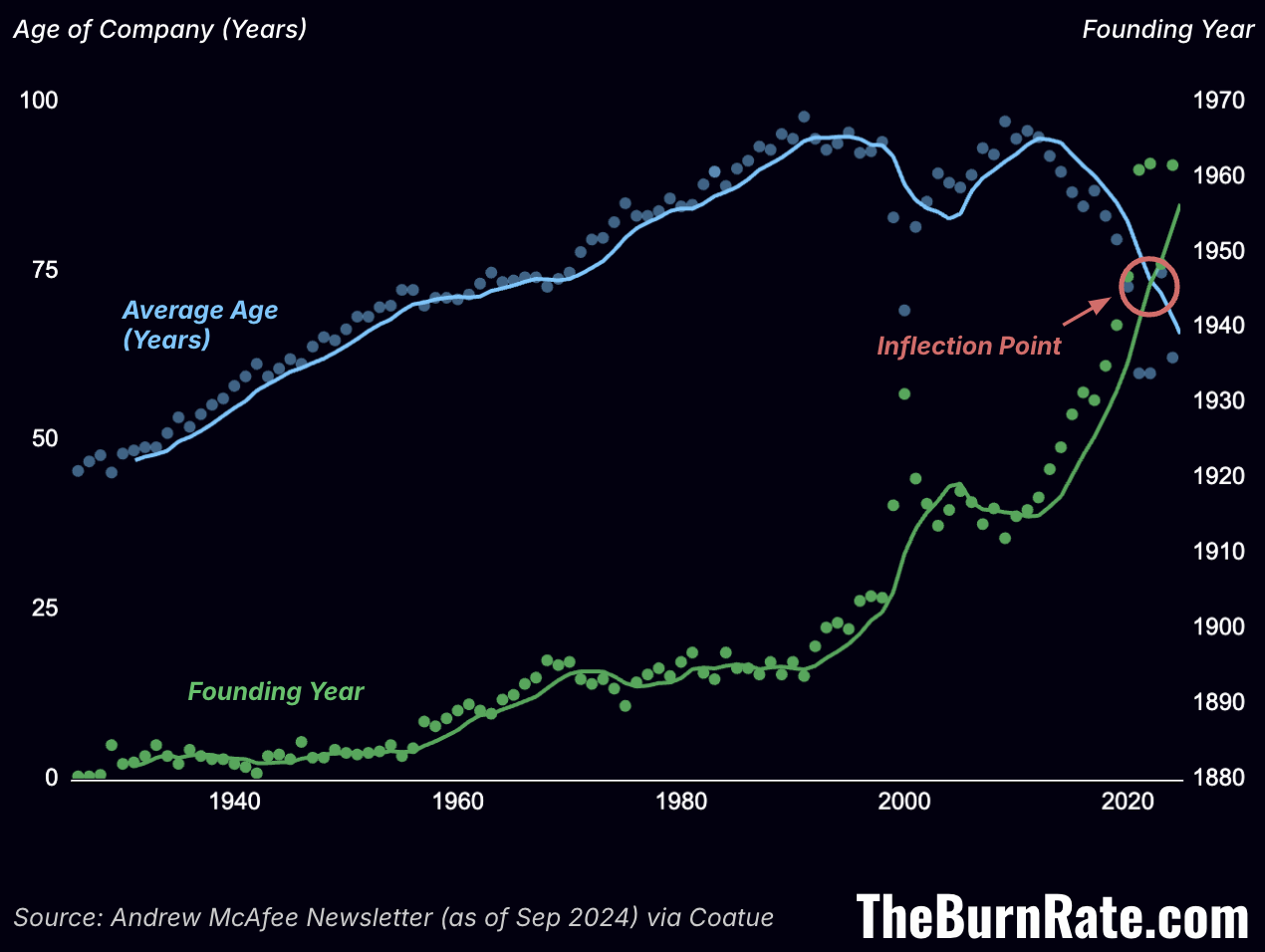
From 1926 through the late 1980s, the dominant companies were also the most established, with their average age steadily increasing. This meant that a company’s longevity was a reliable indicator of its market leadership.
However, beginning in the mid-1990s, this trend reversed. The average age of the largest companies began to decline, a shift driven by a more rapid pace of technological advancement. Companies like BlackBerry and Nokia, as Lafont points out, are clear examples of how quickly market leaders can tumble when they don’t keep up with the times.
Over the past 25 years, this trend has continued, favoring younger and more agile companies. The average founding year of today’s leading companies has moved significantly closer to the present, underscoring the abundance of opportunities still available to emerging firms in our technology-driven economy (especially now in the era of AI).
This single chart serves as a powerful reminder of why the outlook for technology remains exceptionally strong, highlights how innovation continues to be the most disruptive force in business, and emphasizes the need for industry leaders to evolve—or pay the price.
STORIES WE'RE READING
- Apple’s improved LLM Siri is expected to be delayed until 2027.
- Coinbase & Gemini CEOs backed the Bitcoin-only U.S. crypto reserve.
- Alef Aeronautics' actual “flying car” achieved its first-ever city drive/takeoff.
- General Catalyst is considering an IPO.
- FAA is ditching its newly $2.4B contract with Verizon in favor of Starlink.
- GPT-4.5 topped all categories, including coding, math, and creative writing.
- TSMC plans to invest $100B to build 3 new chip plants, 2 packaging plants, and an R&D center in the U.S.
- Firefly Aerospace’s vehicle became the 2nd privately built spacecraft to land on the moon.
- Uber now lets you hail autonomous Waymo taxis in Austin.
- 1/4 of YC’s Winter 2025 startup batch have 95% of their codebases generated by AI.
- JetZero & Delta are developing the 1st commercial blended-wing body aircraft.
CURATED VENTURE DEAL FLOW
- Aescape, a robotics massage company, raised $83M in funding led by Valor Equity Partners with participation from Alumni Ventures and NBA Champion Kevin Love.
- Function Health, a personalized lab testing startup, is raising a new round of funding at a $2.5B valuation led by a16z.
- Ramp, a New York-based financial operations platform, announced a $150M secondary share sale backed by Stripes, GIC, Avenir Growth, Thrive Capital, Khosla Ventures, General Catalyst, Lux Capital, 137 Ventures, and Definition Capital.
- Shield AI, a San Diego-based developer of drone technology for the military, raised $240M in Series F funding from L3Harris, Hanwha Aerospace, a16z, U.S. Innovative Technology, and Washington Harbour.
- Anthropic, the AI startup, raised $3.5B in Series E funding led by Lightspeed Venture Partners.
- Epirus, which specializes in anti-drone systems, raised an oversubscribed $250M Series D round led by 8VC and Washington Harbour Partners.
- Steady Energy, a Finland-based developer of heat-only small modular reactors (SMRs), raised $24M in funding led by 92 Ventures.
Not subscribed? Sign up here.
SHARE THE BURN RATE
Or copy this link: TheBurnRate.com