If you follow AI news at all, you've probably heard of DeepSeek, the OpenAI competitor born out of Chinese hedge fund High-Flyer. Their DeepSeek-R1 reasoning model is making waves with 27.4x cheaper operating costs for complex tasks than OpenAI's ChatGPT-o1 reasoning equivalent.
Silicon Valley and American big tech are panicking over the significant cost savings DeepSeek has achieved—partly how the company brilliantly optimized low-level code (the foundational code that governs GPU operations)—but also because DeepSeek's models are fully open source, meaning anyone, including you, can access and use them right now for free.
This level of success has sparked the question: how did DeepSeek manage to acquire enough AI hardware to rival OpenAI-level performance, especially given the massive data center requirements? While flashy headlines recently were incorrectly reporting DeepSeek spent only $6M to train its model, AI hardware research firms point out that the total server CapEx is likely around $1.6 billion, with operating costs close to $944 million. With DeepSeek's breakthroughs suggesting China is only a few months instead of 2-3 years behind the U.S., authorities are now looking into whether DeepSeek got their hands on NVIDIA's restricted GPUs.
Over the past few years, the U.S. has tightened its export controls to maintain its leadership in AI, adopting a tiered system of restrictions based on each country's relationship with the U.S. Tier One countries include close allies like Australia, France, Ireland, and about a dozen others which are subject to the least restrictive policies. Tier Two covers approximately 120 nations, such as Israel, that face moderate limits on AI chip imports. Meanwhile, Tier Three countries, which include adversarial nations like China, Russia, Iran, and North Korea, faces the strictest restrictions, effectively blocking most access to advanced AI hardware.
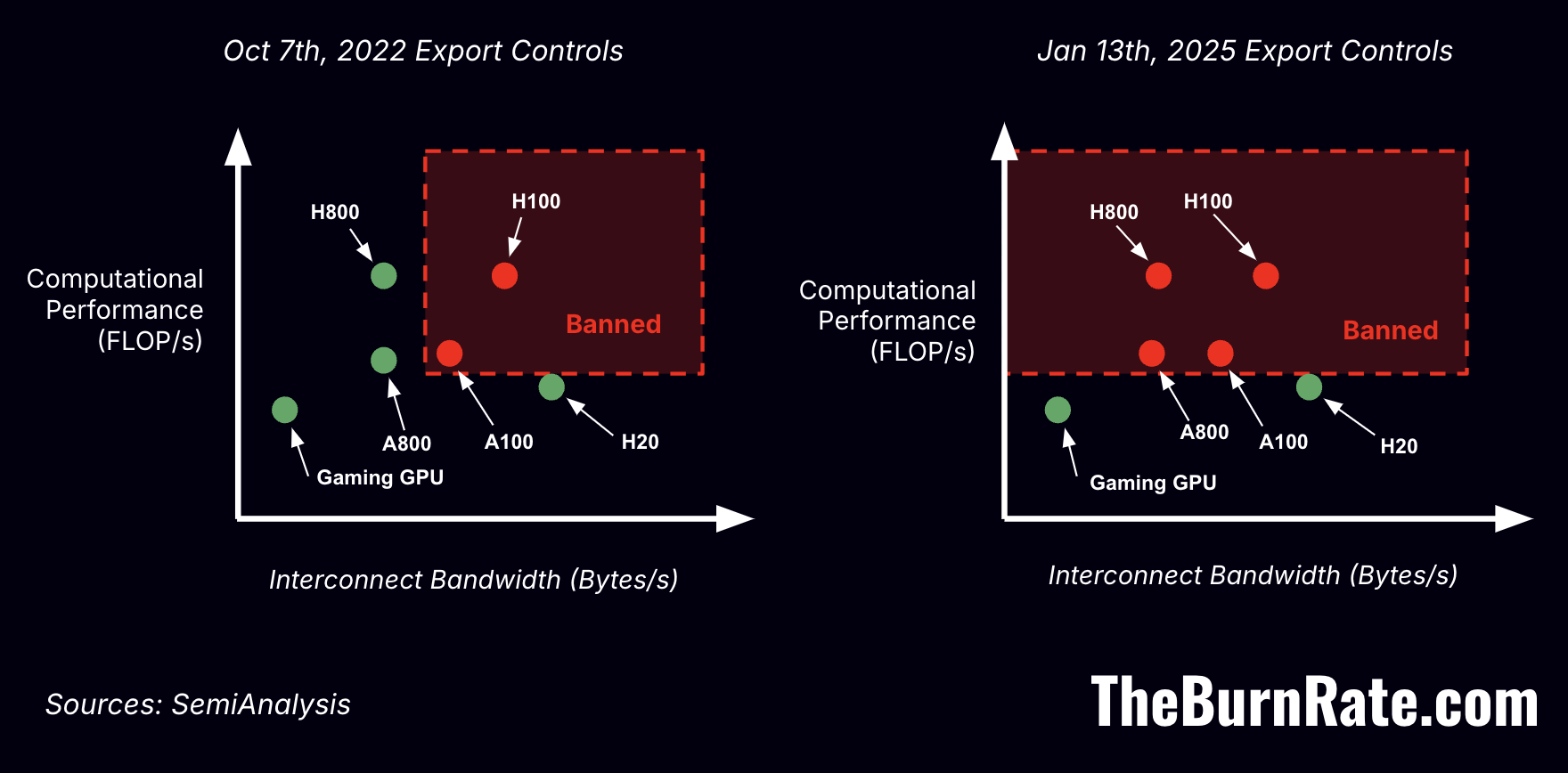
NVIDIA's data center GPU architecture spans several variants —H100, H800, and H200—tailored to different regulatory constraints. The H800 (for the Chinese market) matches the H100 in raw computing power (FLOPS) but is throttled on interconnect bandwidth, whereas the H200 is limited on FLOPS yet offers higher memory capacity and bandwidth. Recent legislation banned the import of NVIDIA's H800s and A800s to China.
The U.S. has implemented further export controls on NVIDIA GPUs destined for China
High-Flyer, the hedge fund from which DeepSeek emerged, is known for embracing AI early in their trading algorithms. The company recognized its potential beyond finance and understood the importance of scaling. They continually expanded GPU resources after testing models on large GPU clusters. By 2021, they had invested in 10,000 A100 GPUs before any export restrictions, which turned out to be a smart move. As High-Flyer's AI activities grew, they spun off DeepSeek in May 2023 to pursue more focused AI research, and now DeepSeek is a significant operation rather than just a side project.
How many (and what type) of GPUs does DeepSeek have now? Top AI research firm SemiAnalysis says this:
"We are confident that [DeepSeek's] GPU investments account for more than $500M US dollars, even after considering export control. We believe they have access to around 50,000 Hopper GPUs, which is not the same as 50,000 H100, as some have claimed. There are different variations of the H100 that NVIDIA made in compliance to different regulations (H800, H20), with only the H20 being currently available to Chinese model providers today.
We believe DeepSeek has access to around 10,000 of these H800s and about 10,000 H100s. Furthermore they have orders for many more H20's, with NVIDIA having produced over 1 million of the China specific GPU in the last 9 months. These GPUs are shared between High-Flyer and DeepSeek and geographically distributed to an extent [and are] used for trading, inference, training, and research."
So, where are all these NVIDIA GPUs that DeepSeek likely possesses actually coming from? The answer appears to be Singapore.
Singapore has recently become a go-to route for bypassing trade restrictions, often by rerouting, rebranding, or reselling exports from the West destined for China. As a global trade hub, Singapore is the perfect location to mask the true origin or destination of goods. U.S. officials suspect that DeepSeek may have obtained NVIDIA's advanced chips through Singapore-based intermediaries, effectively sidestepping U.S. export controls.
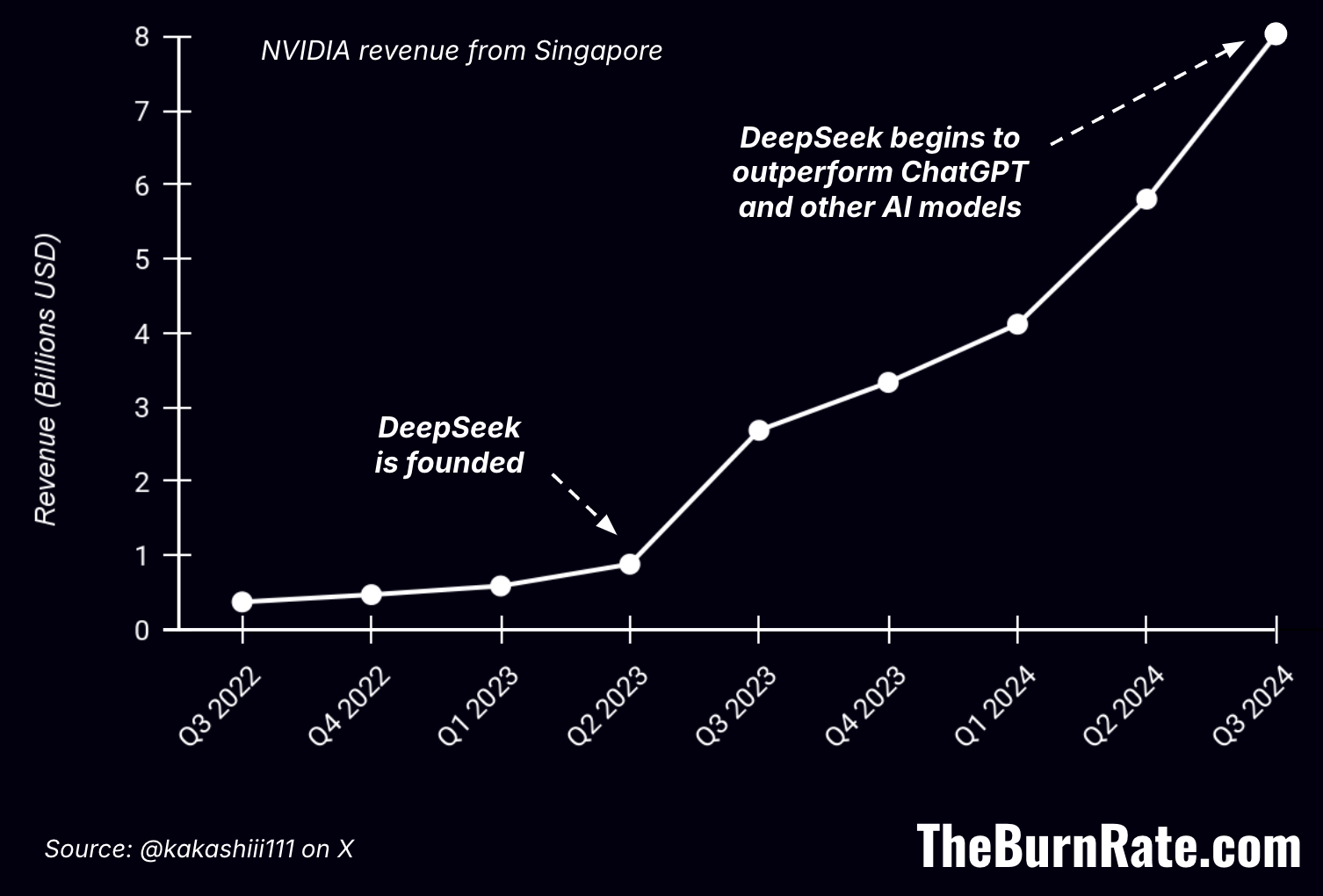
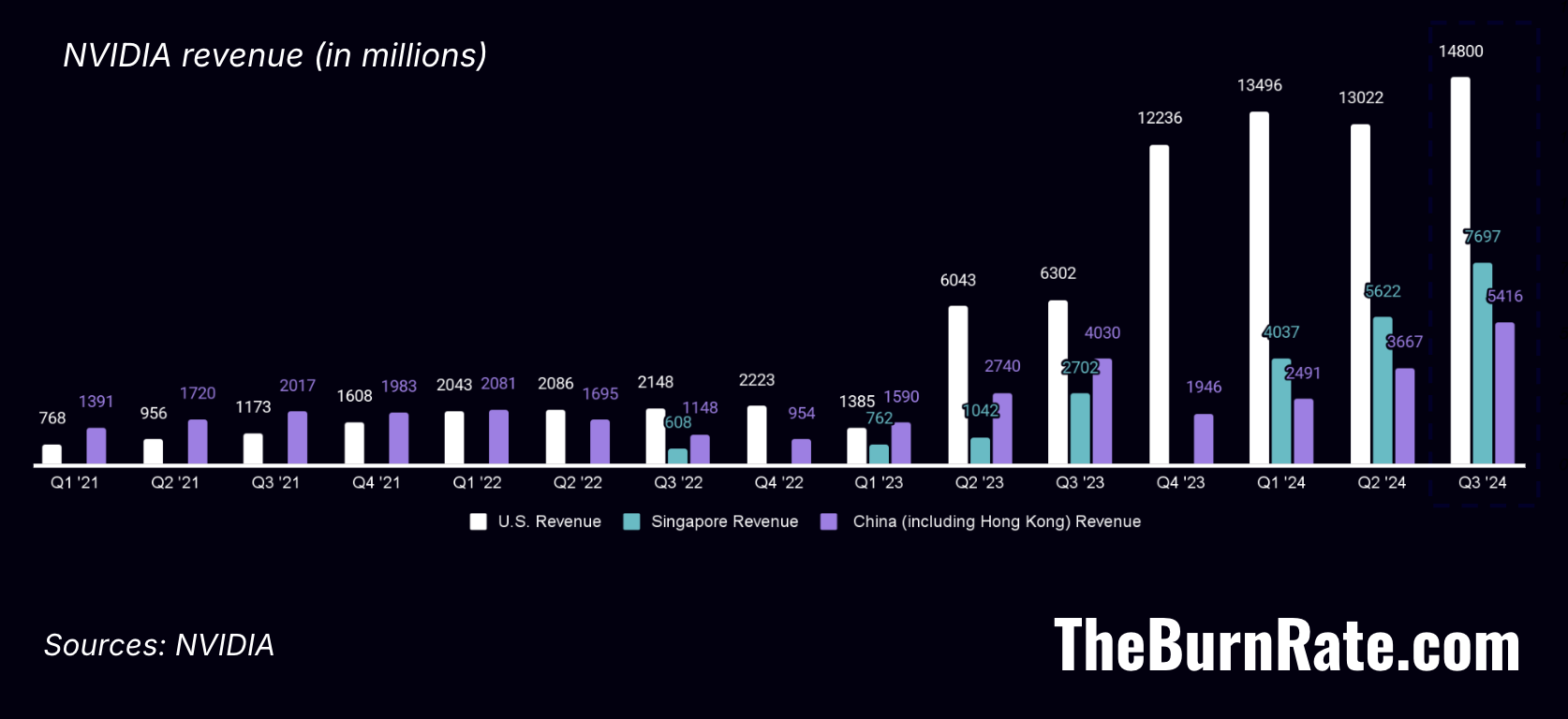
Jumping into the numbers, NVIDIA's sales to Singapore have reportedly skyrocketed 740% since DeepSeek was founded.
NVIDIA's revenue from Singapore has surged since DeepSeek was founded
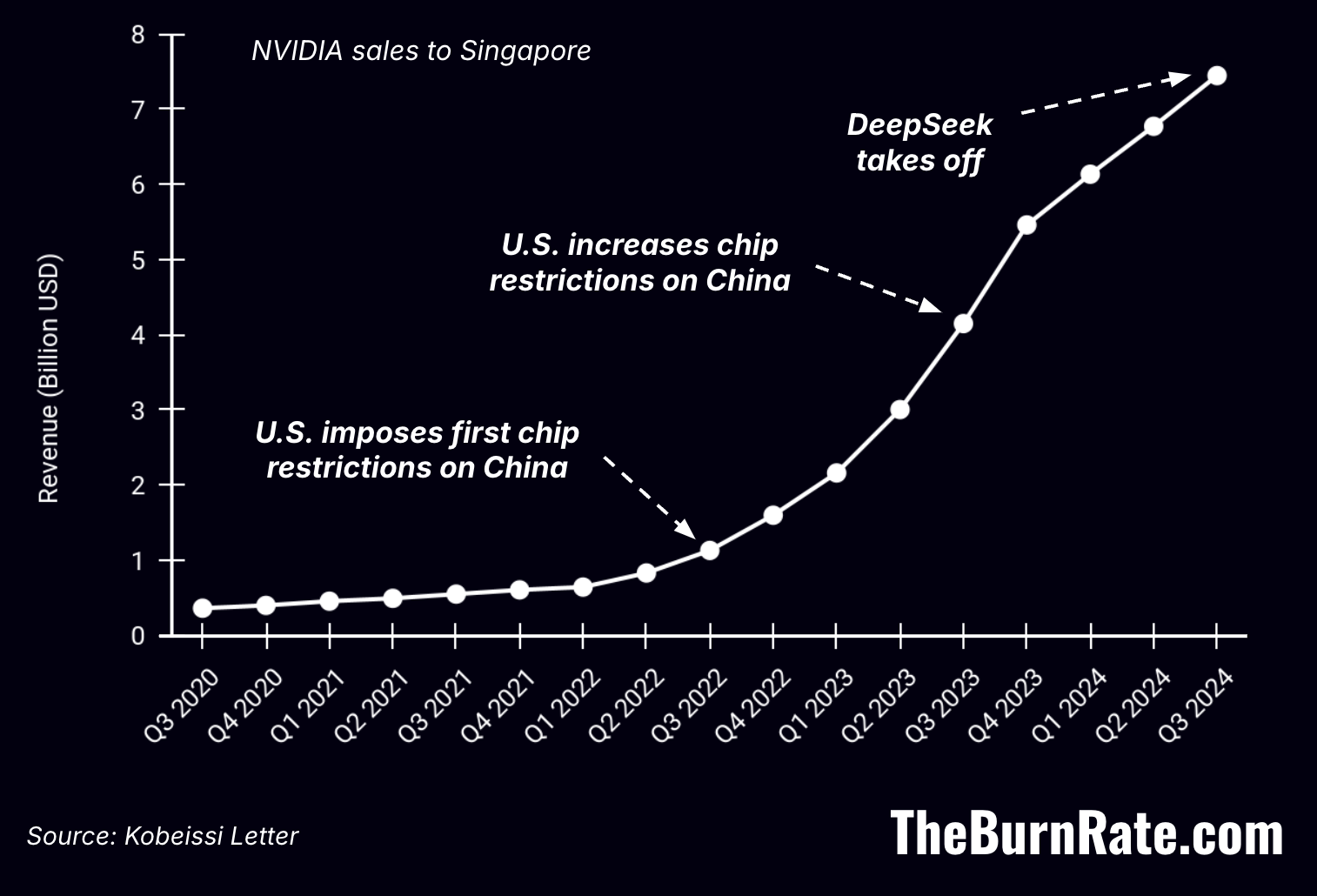
If you compare NVIDIA's sales to Singapore with U.S. chip restrictions on China, you see a growth trend that closely aligns with the timing of those restrictions.
Increased restrictions on China correlate with increased NVIDIA sales to Singapore
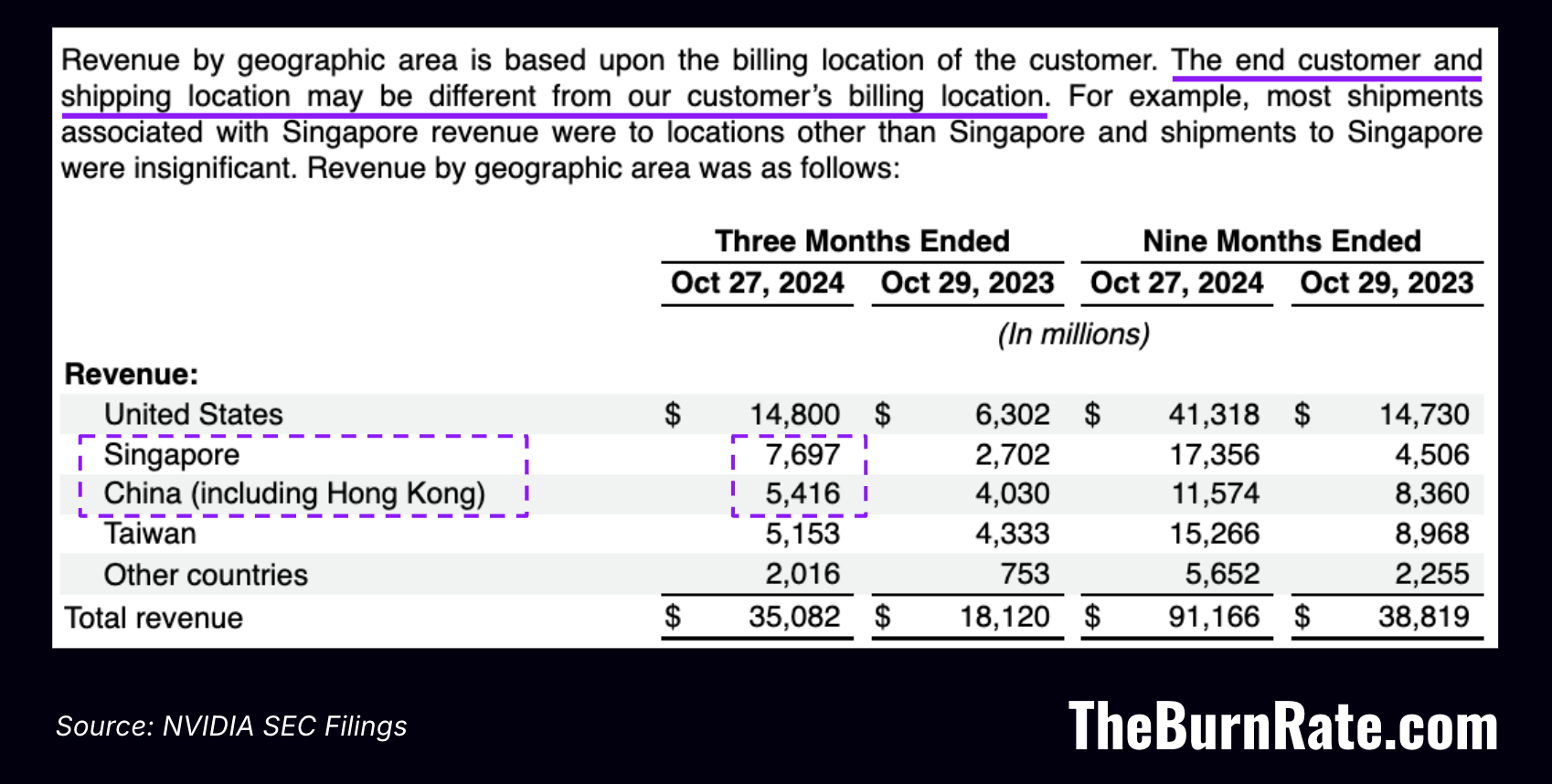
Over the last three quarters, NVIDIA has made more money selling to Singapore (22% of overall revenue) than China, raking in about $17+ billion in revenue from Singapore versus $11+ billion from China. Together the two countries account for roughly 32% of NVIDIA's overall revenue. NVIDIA likely understands their chips aren't being used solely in Singapore and hasn't even tried to cover it up, saying our "end customer and shipping location may be different from our customer's billing location."
NVIDIA has recently made more money selling to Singapore than China
Nvidia's sales to Singapore experienced an impressive 185% year-over-year growth in the most recent quarter. Since Q1 2021, the compound annual growth rate (CAGR) for revenue from Singapore has soared to 278%.
NVIDIA's revenue growth to Singapore is 2x that of the U.S. and 5x that of China
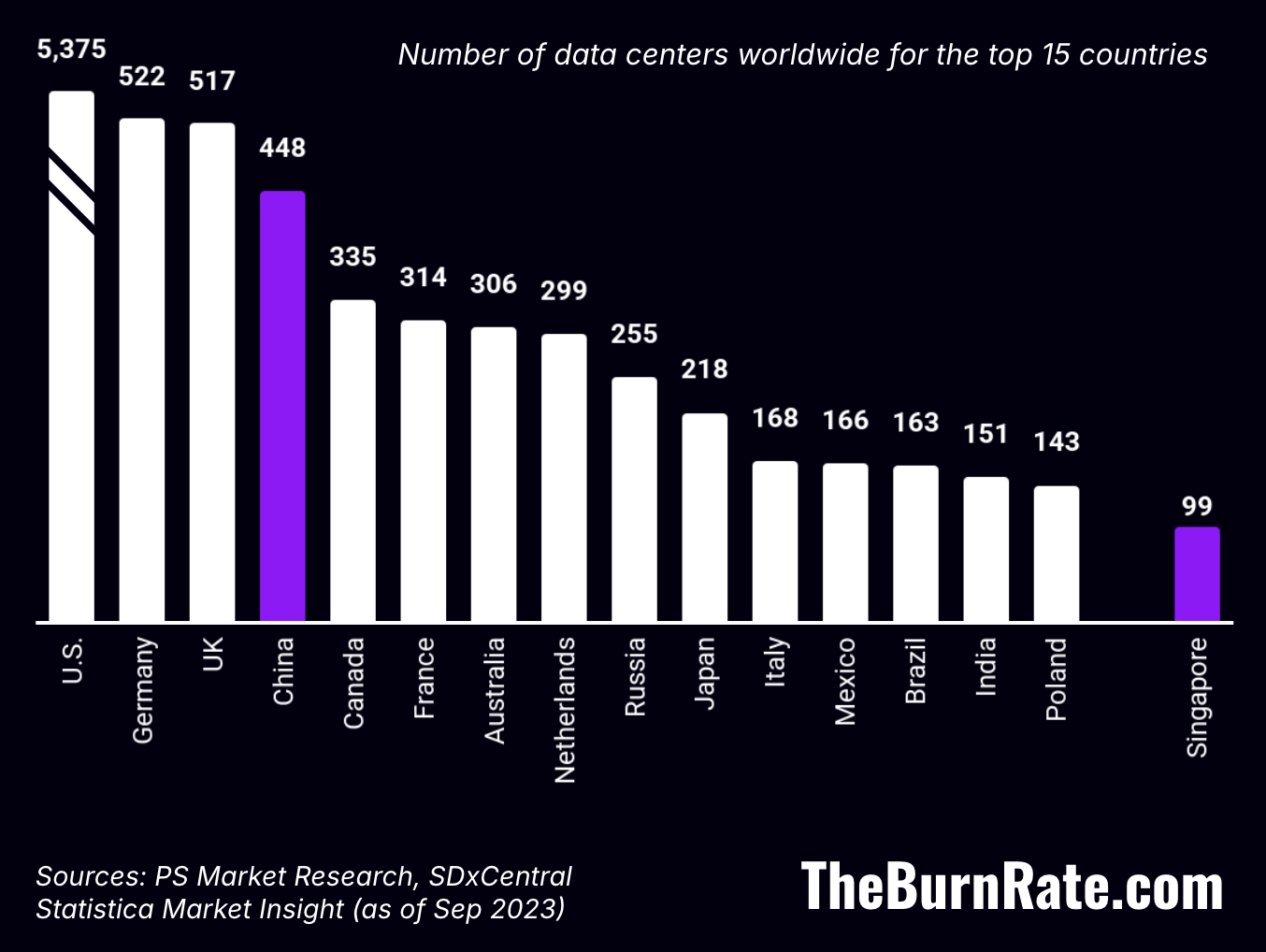
Finally, one could argue Singapore itself needs more GPUs, but the numbers don't add up. Singapore only has 99 data centers, a figure that doesn't justify the huge volume of NVIDIA GPU sales.
Singapore's chip imports dramatically outpace its data center capacity
That's all the data. We'll let you decide whether this is all just a coincidence or if there's a bit of illegal maneuvering happening as goods make their way from Singapore to China across the South China Sea.
Thanks to The Kobeissi Letter for sourcing much of the included data.
STORIES WE'RE READING
- Mistral's new ChatGPT competitor 'Le Chat' has quickly risen to become the top AI app on the App Store, offering free, open-source functionality that runs 13 times faster than GPT-4 Turbo.
- OpenAI whistleblower was found dead in his apartment.
- First human teeth were grown in a pig.
- T-Mobile's Starlink messaging is now free to try, even if you are not on T-Mobile.
- Anduril will take over Microsoft's $22B U.S. Army headset program.
- Ten VC-backed startups (7 AI companies) hit valuations of $1B+ in January, down from 17 last January.
- Quantum computers are 5-10 years away, according to Google's CEO.
- OpenAI will finalize its first custom chip design this year.
- Elon's $97.4B unsolicited bid for control of OpenAI was rejected by Sam Altman.
- Longest subsea cable project is underway by Meta.
- Anthropic projects its revenue to be $34.5B by 2027.
- Lyft will partner with Intel's Mobileye and Japan's Marubeni to launch a robotaxi fleet by 2026.
CURATED VENTURE DEAL FLOW
- Anduril, the defense tech startup, is in talks to raise $2.5B at a doubled $28B valuation in a round led by Founders Fund.
- Gridraven, using AI to increase electric grid capacity by 30% with software alone, raised $4.2M in early-stage funding co-led by 42CAP and Icebreaker VC.
- Olipop, the prebiotic soda brand, raised $50M in Series C funding led by J.P. Morgan Private Capital’s Growth Equity Partners.
- Collie, a Dutch developer of smart cow collars for remote herding, raised $3.6M in Seed funding from Freigeist Capital.
- Edacious, a radical transparency-based food verification system, raised $8.1M in Seed funding led by Tin Shed Ventures.
- Self Inspection, an app that lets you conduct car inspections from your phone, raised $3M in Seed funding co-led by Costanoa Ventures and DVx Ventures.
- Epicore Biosystems, a digital health solutions company developing advanced sweat-sensing wearables, raised $26M in Series B funding led by Steele Foundation for Hope.
- Lingopal.ai, a real-time speech-to-speech translation company, raised $14M in Series A funding led by DCM Ventures.
- Modern Synthesis, a London-based developer of biodegradable grown nonwoven materials, raised $5.5M in late-stage funding led by Extantia Capital.
- Groq, an AI hardware and software developer, raised $1.5B in late-stage funding from Saudi Arabia.
- Fal, a generative AI media platform for developers, raised $49M in Series B funding co-led by Notable Capital and Andreessen Horowitz (a16z) with participation from Bessemer Venture Partners.
- Apptronik, a humanoid robot company, raised $350M in Series A funding led by B Capital and Capital Factory with participation from Google.
- Arcube, a passenger intelligence platform that unlocks untapped loyalty and ancillary revenue for airlines post-flight, raised $1.5M in Seed funding co-led by Fuel Ventures and Oxford Capital Partners with participation from the Chairman and former CEO of Pegasus Airlines and the founders of PointsYeah.com.
- Agteria Biotech, a Sweden-based startup aimed at reducing livestock methane emissions, raised $6.3M in Seed funding co-led by Industrifonden and AgriZeroNZ.
- Legend, a DeFi superapp, raised $15M in early-stage funding co-led by Coinbase Ventures and Andreessen Horowitz (a16z).
- QuEra, a neutral-atom quantum computing company, raised $230M in Series B funding led by Google and SoftBank.
Not subscribed? Sign up here.
SHARE THE BURN RATE
Or copy this link: TheBurnRate.com